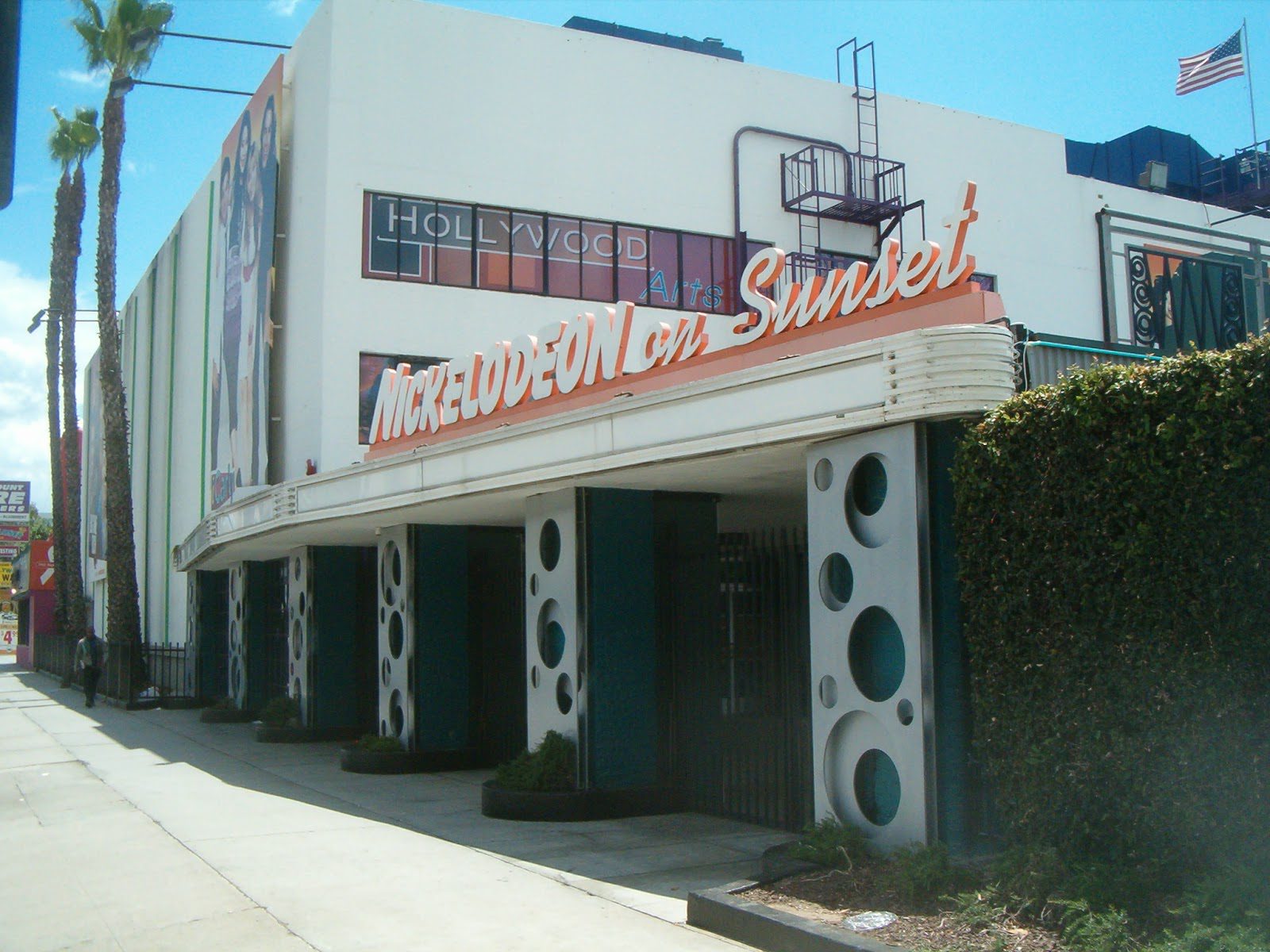
This legendary theater is known for its rich history. It was opened in 1938 by Earl Carroll, a famed theatrical producer and director celebrated for his spectacular musical revues. Located in Hollywood, California, the theater quickly became a center of entertainment and elegance. More at los-angeles-trend.
The Theater’s Founding
He was called “the troubadour” and “the most notorious connoisseur of female flesh in show business history.” Earl Carroll was Florenz Ziegfeld’s only real competitor in the late 1920s and early 1930s, but he left Broadway under a cloud of scandal and bankruptcy. Seeking a fresh start, he decided to reinvent himself in Hollywood. Earl Carroll built his first theater in New York and his second in Hollywood, California, which opened on December 26, 1938. Over the entrance to both theaters, Carroll inscribed the words: “Through These Portals Pass the Most Beautiful Girls in the World.” The theater stood out from the rest. It was a glamorous supper club-theater featuring unique shows, a water curtain, an orchestra lift, a small round “singers’ lift” under the stage, and a revolving tower of four pianos. The building’s architect was Gordon B. Kaufmann. The construction cost was estimated at $500,000. The facade was adorned with one of Hollywood’s most famous landmarks: a 20-foot-tall neon portrait of Beryl Wallace, the founder’s devoted companion. Another notable feature was the “Wall of Fame,” which featured over one hundred individual concrete blocks autographed by Hollywood celebrities, including some of the biggest stars of the 1930s and 1940s. Later achieving various degrees of fame in film and television, Jean Spangler, Mara Corday, Yvonne De Carlo, Phyllis Coates, Maila Nurmi, Gloria Pall, and Mamie Van Doren were among the performers who graced the theater’s stage. The theater was a popular spot for many of Hollywood’s most glamorous stars and powerful film industry players.
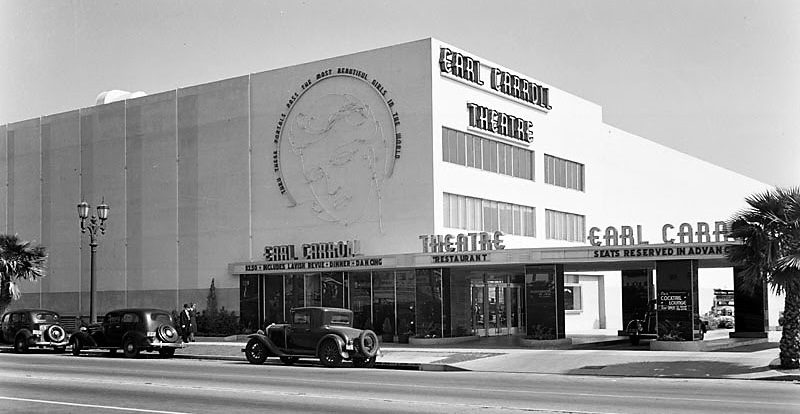
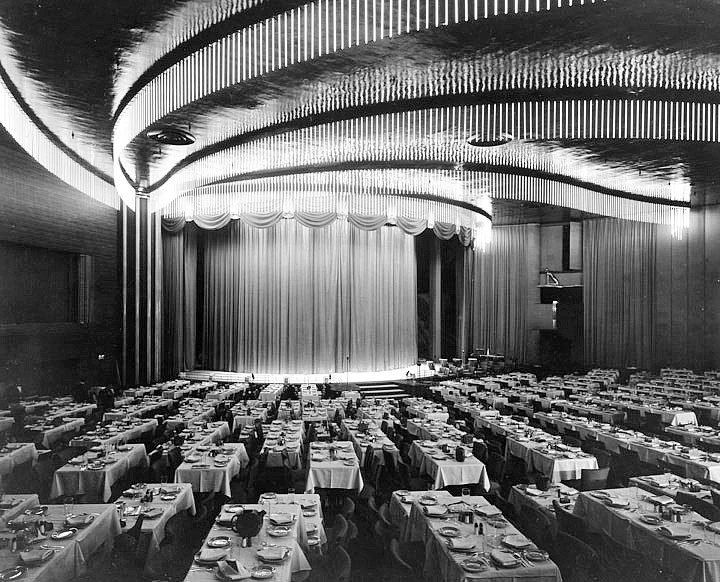
The theater had a seating capacity of 1,000. It quickly became famous for its massive revues featuring a cast of 60 showgirls performing atop a double revolving stage. Guests were dazzled by over six thousand feet of blue-and-gold neon and massive 30-foot illuminated columns. For $1,000, a VIP membership guaranteed a lifetime waiver of the cover charge and reserved seating.
After World War II and nearly a decade in Hollywood, Earl Carroll unveiled plans for a $15 million facility that promised to be the world’s largest movie theater and broadcast studio. It was to be erected half a block east of the theater building. Larger than Radio City Music Hall, the 7,000-seat theater’s design included a 130-foot stage, three revolving stages, and an ice rink adjoining a water tank.
The Founders’ Tragic Death
Tragedy struck on June 17, 1948, when United Airlines Flight 624 crashed in Pennsylvania. Earl Carroll and Beryl Wallace were among the 39 passengers who died instantly. Carroll had always said that “the show must go on.” And so, on the theater’s stage, the grieving showgirls appeared the very next night to perform the “Earl Carroll Vanities” with Virginia Dew. Carroll and Wallace were interred together in the Garden of Memory at Forest Lawn Memorial Park in Glendale, California.
From Theater to Television Studio
After the deaths of Earl Carroll and Beryl Wallace in the 1948 plane crash, the theater was sold. It continued to operate, but fell on hard times in the early 1950s. In 1953, Las Vegas showman Frank Sennes reopened the theater as a nightclub called the “Moulin Rouge.” The popular television game show “Queen for a Day” was broadcast from the building from 1956 to 1964. In late 1965, the theater was renamed “Hullabaloo” and became a rock-and-roll club, often catering to a teenage audience. For a few months in 1968, it was called the “Kaleidoscope,” featuring top West Coast rock groups, with an emphasis on local bands like The Doors.
The theater experienced both highs and lows over its existence. The original name and ownership were completely removed during a major overhaul in 1968, when the theater became a face of psychedelic art. It was renamed the “Aquarius Theatre” and became the Los Angeles home for the Broadway musical “Hair.” It occasionally hosted rock concerts and is famous as the venue where The Doors performed and recorded live shows on July 21, 1969.
In 1983, the Pick-Vanoff Company purchased the property and converted it into a state-of-the-art television theater, which served as the taping location for “Star Search” for nine years. The Pick-Vanoff Company also owned Sunset-Gower Studios, formerly the home of Columbia Pictures. For many years, the theater was used for Jerry Lewis’s annual “MDA Labor Day Telethon.” In the fall of 1993, the theater was the home of “The Chevy Chase Show” on the Fox Network, renamed “The Chevy Chase Theater.” The talk show suffered low ratings and was canceled after only five weeks.
In the late 1990s, the theater’s name was changed to “Nickelodeon on Sunset.” The building became the West Coast television production headquarters for Nickelodeon after the cable channel purchased the theater.